THE UNIT
Crown to chin
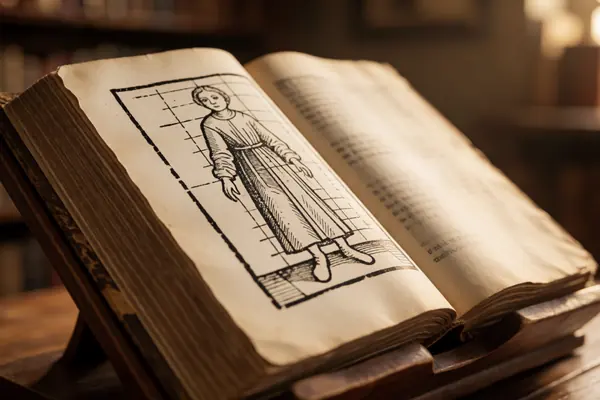
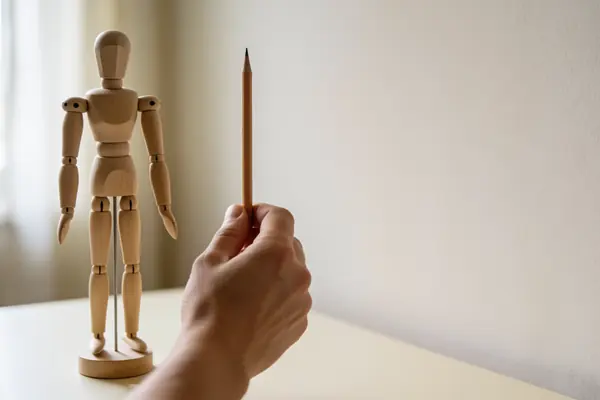
In modern figure drawing the basic unit is the head, the distance from the top of the head to the chin. Other lengths are checked against it.
Pick a canon doodlebody
A FIGURE-DRAWING GUIDE
The oldest drawing trick uses a ruler you always carry.
Pick a canon
1 HEADthe artist's ruler
Figure-drawing teachers use the head, from crown to chin, as the unit for the whole body. The idea goes back to ancient Greece and Rome, through Leonardo and Dürer to art classes today. Here are the numbers and what they are for.
At a glance
⅛
Head, chin to crown, as a share of height
Vitruvius also gave the face and the open hand as a tenth of the height, the foot as a sixth and the forearm as a quarter.
VITRUVIUS · BOOK III
7½ heads
Average person, measured in heads
Art anatomy texts put the average person at about seven and a half heads tall, while the classical and Renaissance custom was to draw eight.
ARTISTIC ANATOMY
TWO NUMBERS WORTH KNOWING
The Roman rule rounds up the head count.
Artists often follow it on purpose.
Leonardo's Vitruvian Man (about 1490), now in the Gallerie dell'Accademia in Venice, sets out these Vitruvian measures in mirror-written notes above and below the figure.
HOW TALL, IN HEADS?
Artists choose different head counts for different effects. Pick one to see what it is used for. The bar shows how tall the figure is drawn, in heads.
Based on Wikipedia's Body proportions article, which summarises artistic anatomy texts, and Vitruvius, Ten Books on Architecture, Book III.
THE SHORT ANSWER
Modern figure drawing counts in heads.
The unit is credited to the sculptor Polykleitos.
THE UNIT
In modern figure drawing the basic unit is the head, the distance from the top of the head to the chin. Other lengths are checked against it.
Pick a canonTHE CANON
Vitruvius wrote that the head from chin to crown is an eighth of the whole height, and the face from chin to hairline a tenth.
The Roman rulesTHE PRACTICE
Art anatomy texts often set the figure at eight heads, with the halfway mark at the hip joints, on a line between the tops of the thigh bones.
Try it
FOUR CHECKS FOR A STANDING FIGURE
These checks come from the classical rules and the artistic anatomy texts summarised above. Treat them as scaffolding, not a cage: some teachers prefer you learn to judge proportion by eye.
Draw the head in the top band. The halfway line, after band four, falls at the hip joints, just above the pubic arch.
Legs, floor to crotch, run about three and a half to four heads. Arms measure about three heads.
A hand is about as long as the face, chin to hairline. Vitruvius gave both as a tenth of the height.
Arms stretched out sideways span about the same as the figure's height, the square in Vitruvius and Leonardo's drawing.
WHERE THE RULES CAME FROM
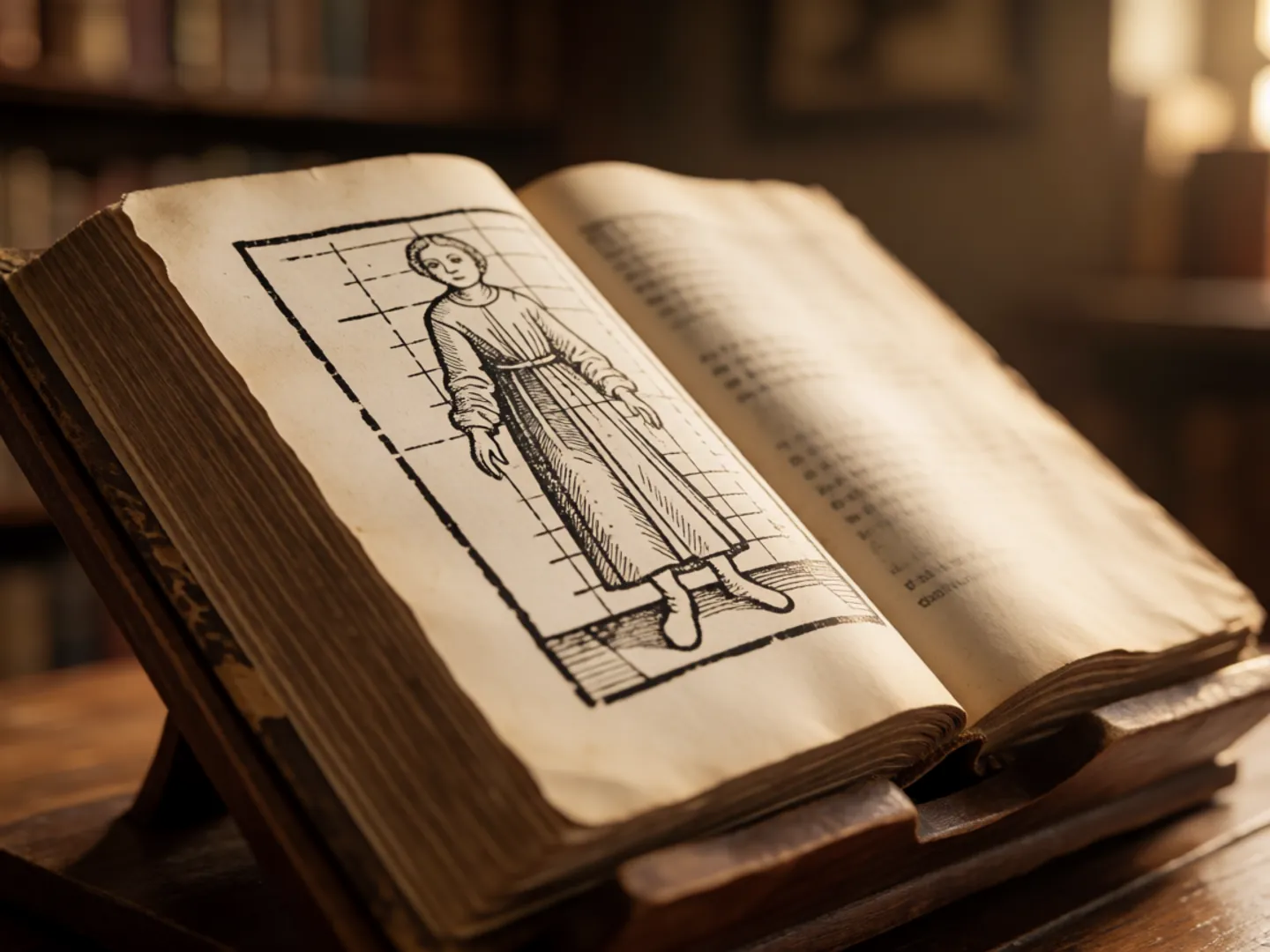
Vitruvius, a Roman architect, used the well-proportioned body as a model for temple design. He wrote that a man lying with arms and legs stretched out fits a circle centred on the navel, and that his outstretched arms equal his height, making a square. Leonardo drew both about 1490.
Albrecht Dürer, in his Four Books on Human Proportion, went the other way. A University of Texas Health library article says he drew men and women of many shapes and sizes, believing beauty was found in the sum of all people. Ancient Egyptian artists used a different unit again: the fist, with 18 from the ground to the hairline.
Questions
Artistic anatomy texts give an average of about seven and a half heads, including the head. Artists often draw eight for a more dignified, idealised figure.
That is the classical rule. Vitruvius wrote that outstretched arms measure the same as the height, and Leonardo's Vitruvian Man shows it as a square. Real people vary around it.
Wikipedia's summary of artistic anatomy credits the head unit to the Greek sculptor Polykleitos, of the fifth century BCE, whose written Canon of proportions is now lost.
Not necessarily. The same summary notes some teachers discourage mechanical measuring and advise learning to estimate proportion by eye alone.
No. Dürer drew many body types, and Mannerist painters exaggerated proportions for effect, as in Parmigianino's Madonna with the Long Neck.
Sources
ABOUT THIS NAME
doodlebody.com is part of the DoodleSale portfolio. It isn't in an auction right now, but you can ask about leasing it.